Pumpernickel & Peanut Butter: Why Weird Works
Originally published as an ebook in 2019, Pumpernickel & Peanut Butter is now available to read here, unaltered and in its entirety. Through original charts, tables, and case studies, it serves as a guide to being weird in a world that demands normalcy.
The book explores seven reasons why weird works, when it doesn’t, why it’s difficult to maintain, and how to reclaim your own weirdness if you’ve lost it. Above all, it challenges you to consider why you haven’t been compounding your weirdness all along.
I hope you enjoy it. If not, just remember: I wrote this seven years ago. 🙃
Douglas Vigliotti, 2026
Author’s Note
The whiteboard above my desk reads, “Have fun or don’t do it!”
I’ve gone about life both ways—the boring way and the fun way—and trust me, fun is the way to go. I get it, though. Most things aren’t fun. Working out sucks. So does going to work or visiting the in-laws. And we both know reading can be boring, too. Even for writers, writing isn’t exactly fun. It’s time-consuming, lonely, and at times, feels like self-induced torture. But life is too short to not infuse it with fun. So if at any point while reading Pumpernickel & Peanut Butter, you’re not enjoying it, you should stop reading it.
Pumpernickel & Peanut Butter isn’t a book about fun, though. It’s a book about weird. And I hope it will inspire you to embrace your weirdness, because we both know you’re a little weird. More importantly, it will show you why you should and how you can. You ready?
Okay, now let’s have some fun.
How it all began…
It’s August 11, 2018, and I’m standing in line at New York City’s best bagel shop. The tequila from last night isn’t making this easy on me. All I can see is person after person, no end in sight. The line behind me goes out the door, and each time it opens, I feel the heat radiating off the Manhattan streets. The combination of sticky air, smell of the warm bagels, and the pitter-patter banter of patrons has me on edge. I feel like I’ve been waiting for three hours. Or maybe that’s just the tequila asking: “Hey, shit-for-brains, you plan on feeding me or what?”
Finally, the counter’s in sight. A big chalkboard menu hangs behind it. All the options are pre-determined and laid out in fast-food style. Brainless operation, really. With each, “I’ll have Number 1, please,” “Number 4, please,” “Number 2, please,” the line gets shorter, and I get more antsy. It can’t move much faster, though. The machine seems well-oiled. The real agony is watching someone stutter out, “Num..Number...2…Wait, actually Number 3...No, no I’ll have a Number 2...Oh, but can you put the cream cheese on the side?” There I am, doing all I can to keep the tequila from screaming, “Are you fuckin’ kidding me? You waited in line for thirty minutes, and you have no clue what you want?”
Forever later, I find myself standing in front of a young girl asking me, “So what would you like, sir?”
Those words feel like a Swedish massage. Without thought, I reply, “I’ll have a pumpernickel and peanut butter, please.”
The young girl working the counter looks at me like I have three heads, then yells back to her co-worker, “Do we have pumpernickel and peanut butter?”
It was like I’d stuck a wrench in one of the wheels, oil drained out, and that machine came to a screeching halt. The tequila wastes no time grabbing her attention: “I meant a pumpernickel bagel with peanut butter on it!”
“Ohhh, never heard of that. I think we can do it.”
I finally had the spirit to tell the tequila, “Relax, will ya!” So I apologize to the young girl for any abruptness. But now I’m left wondering, Is pumpernickel and peanut butter really that weird?
What is weird?
Well, first let me define the word weird as I see it. Weird is anything that’s not normal. Normal is the majority. Normal is what everyone else is doing. Normal is the standard way. Normal is the thing that ensures you’re relevant to the world. Normal is normal. We could get all politically correct, but stop it. We all know normal. When I talk about weird, I’m referring more to the adjective defined by Merriam-Webster as “of strange or extraordinary character.” It’s really important we’re on the same page; otherwise, everything you’re about to read will render itself useless. As you might be able to imagine, weird comes up a lot in this ebook, and you need to know what I mean by it. So yes, by that definition, pumpernickel and peanut butter could be weird. But then again, so could a lot of things.
Have you heard of Hunter S. Thompson? Probably, right? No? Okay, well, here’s what you need to know. He was a writer who created what came to be known as gonzo journalism: a style of writing in which the reporter inserts themselves into the narrative of their piece. At its best, it strives to be an objective firsthand account of whatever you’re writing about. It makes sense, too: if you’ve experienced “it” directly, then theoretically you’re going to have unique insight. It sounds like something many people could do. But where does “gonzo” come into play? Thompson was known to love a jazz song called “Gonzo” and played it over and over again while covering the 1968 Richard Nixon campaign. The term was actually Cajun slang for “to play unhinged.” This was largely Thompson’s career: inserting himself into a piece and playing unhinged.
Thompson might have been the weirdest person to ever walk the earth. I know that’s a bold claim, but the guy was seriously weird. How weird? Here’s what Jann Wenner, his editor of thirty-five years at The Rolling Stone, said about their first encounter:
Here’s this big guy; kind of awkward and clumsy – not knocking anything down exactly, but kind of lumbering in. He had his Converse sneakers and wore a pair of shorts and polyester multicolored shirt, I think the famous one with red circles on it. He was also outfitted with a gray bubble-top ladies’ wig and had those small-lens dark glasses on and was carrying his leather satchel. And he had his cigarette holder.
I’d seen a lot of stuff [...], but this guy was strange. He sat down and put his satchel on my desk and started to slowly unpack things. I sat there watching all this – and at that point I was a pretty young budding entrepreneur trying to get things done – and he was very slowly unpacking his satchel, pulled out a couple six-packs of beer, a bottle of scotch or something or other, can openers, knives, cigarettes, smoking paraphernalia, notebooks. An air horn. He put everything out on the table, and then he slowly sat down after circling the room and started to mumble as he took more things out.
Thompson was the epitome of weird. He read in the paper about a random guy certifying people as a Doctor of Divinity in some basement in Evanston, IL. So he flew there to get certified, stating, “This is great, because you get cut rates on hotels. And you know, it always sounds good in an airport when you hear ‘Paging Dr. Thompson.’”
Not weird enough for you?
He once flew to Zaire to cover the iconic Rumble in the Jungle fight between Muhammad Ali and George Foreman, and then didn’t even show up to the fight. Norman Mailer, a fellow writer who was there covering the fight, said, “What he decided to do was to see the fight with Mobutu, who was the dictator of Zaire. He made a real effort to get together with Mobutu–and failed.” That was strike one for Thompson. According to his longtime illustrator and friend Ralph Steadman, “All Hunter was interested in was finding out where John Daly–this entrepreneur who was supposed to be the promoter of the fight–had got the money from to put the fight on.” And when that didn’t work out, I guess for Thompson that meant no dictator, no promoter, no fight coverage. What does he do next? Steadman said, “On the night of the fight, Hunter had a big bag of marijuana, and he took a bottle of Glenfiddich I had bought him down to the pool with a bucket of ice and the bag, threw the marijuana into the pool–everyone else was watching the fight, you know–and dived into the middle of the marijuana and then just hung by the side of the pool, smoking and drinking and loving the whole meaningless nature of it.”
So I’m not suggesting you do drugs, drink alcohol, smoke cigarettes, and carry around knives in a satchel. Nor am I suggesting you blow off assignments, but there is still something to learn from Thompson. He searched for the weird take on the story. He didn’t care two iotas about relevancy or normalcy. Thompson wanted only different, odd, or strange. Thompson pioneered gonzo journalism and changed writing forever. Maybe your kind of weird can pay off in the long run, too.
You might be wondering, Is Doug weird?
It’s hard to know if you’re weird or not, but here’s what I’ve got for you.
For as long as I can remember, I have enjoyed the idea of “different.” In a prom picture of twenty couples with every guy wearing a black tux, I was wearing a white one. At a summer party while everyone was wearing sneakers, sunglasses, and polos, I was wearing water shoes, a sombrero, and a tank top. I’ve been shaving my head since I was 21. No, not with a buzzer—like bald, bald. Actually, I like to shave my body, but keep my beard. Wait, let me take that back. Sometimes I let my chest hair grow because I like the way it looks. I guess that’s pretty weird.
I know I’m not living the standard narrative. I’m thirty-three, single, no white picket fence or kids in sight. I also know I’m far from perfect. I cry. I kick and scream. I stutter and slur. I smile too much. I think every idea I have is an amazing one.
Maybe I’m weird because I wrote this eleven-thousand-word ebook on embracing your weirdness. Or because I wake up every day at 5am. I am an extrovert who loves to read, write, and think. Most people think that’s pretty weird.
Once, I almost bought a painting just because the frame was crooked. My girlfriend at the time convinced me not to. I’m still upset about it. I recently commissioned an artist to paint me a couple exact opposites of Andy Warhol paintings that I’m titling, “Anti-Warhol Collection.” Is that weird to you?
I enjoy making myself and others emotional. I watch sad movies, listen to love songs, and read books about life and death. I have empathy for strippers, celebrities, and bad guys in movies. I live in a town with two gyms next to each other, and I go to the one with all the old people. How old? The featured club is called SilverSneakers.
I love not knowing where a night might take me. I wear expensive shoes, tight jeans, and show off from time to time. Stop it. You have an ego, too. Everything about me from the outside looking in might suggest I’m not a writer. Yet here I am, writing.
Oh, and of course, I eat pumpernickel and peanut butter bagels.
Does all this make me weird? I don’t know. I think my friends might say so. Probably my family, too. But the biggest moments I regret in my life are the moments that I played follow the leader. On the contrary, I’m most proud of the moments when I had the courage to stick my neck out and do something different. I don’t understand why people do things just because that’s the way they’ve always been done. It makes no sense to me.
But what I do know? I’m embracing whatever I am. Maybe that’s your version of normal.
Either way, I know you have some weird in you, too. That’s the dichotomy of weird. My weird might not be your weird, but we’re all weird in some weird way. This actually makes weird, normal.
So join the ride. It won’t be easy, but it’ll be worth it. I promise.
Is it hard to be weird?
Right now, the average life expectancy on a global level is approximately seventy-two years. This number obviously takes into account every country in the world. Since you’re likely reading this in a developed country, your average life expectancy will likely be higher. How much higher? Canada is approximately eighty-two years. The United Kingdom is approximately eighty-one years. The United States is approximately seventy-nine years. I like round numbers, and I think you get the point. So let’s just assume you’ve got about an eighty-year run in you.
*Handwritten in 2019 by Douglas Vigliotti
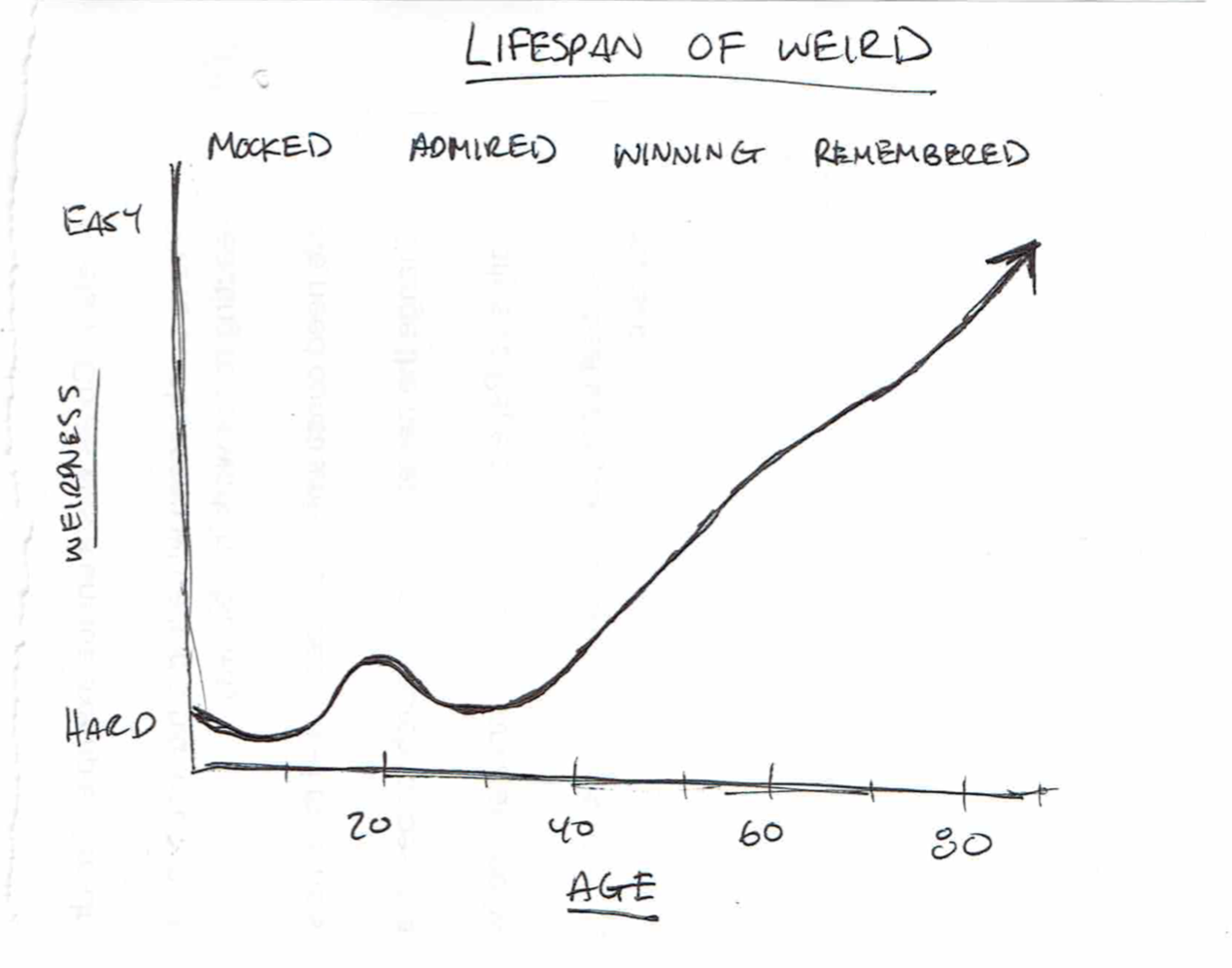
This means we could divide your life into four quarters in twenty-year increments to get a snapshot of your life. Let’s look at what those four quarters look like in terms of how easy or hard it is to embrace being weird throughout your life. Are you getting scared? Don’t be. This will be fun. Meet the Lifespan of Weird.
Quarter 1—Weird is mocked.
From the day you’re born to age twenty, being weird sucks. There’s no way around it. It’s hard because you really don’t know anything. You’re born helpless and confused, then molded to whatever the fuck. It’s kind of like one big lottery.
All little kids are weird, and left up to their own devices, with no pressure from the outside world, they will be weird. They’ll pretend they’re superheroes, play make believe, and pick their noses. The world pressures kids to be normal. Nobody wants to be the kid who picks his nose, wipes it under his seat, and sits in the corner in silence. Nobody wants to have no friends. You’re trying really hard to be normal. Plus, there’s tons of pressure to do so. As you leave grade school and go into middle and high school, this pressure only increases with sports, dating, sex, bullies—you name it. It’s hard growing up.
Things change a little bit as you leave high school and enter college (if you go to college) because now you’re starting over. Nobody knows you. You have more freedom to find your weird self and embrace it. That’s why you’ll see a little spike in the Lifespan of Weird chart from 18-21. Many find and embrace their weirdness in their college years and never look back. The pressure to be normal doesn’t let up, though, as alcohol, drugs, and partying come into the picture. A common narrative for this time in your life. It concludes with overwhelming pressure from friends, parents, and social media to find a job and start your career. Hurry up, start being normal. We need to make sure you’re comfortable and relevant. You can’t end up like that kid sitting in the corner picking his nose.
The first quarter is a difficult time to be weird. Without question. However, assuming you’re brave enough, you can really get a leg up on the world by embracing your weird early. More on that later.
Quarter 2—Weird is admired.
As you get into the second quarter of life—twenty to forty years old— the narrative on weird starts to change a little bit. You’re just graduating college or starting your career in some capacity. Getting going in the workforce is a nerve-wracking time. You’re unsure. You’re uncertain. You want to impress your boss and make a name for yourself. Some people seem to be doing much better than others out of the gates. There’s a lot of pressure to be normal. Let’s assume you meet the “right one” during the first part of this quarter. You’re likely to fall into the married, house, kids bucket. With that narrative, honestly, who has time to be weird? If that’s you, don’t worry; you can still be weird. It’s just a little harder. Certainly, each situation is going to be a little different, but you get the big picture.
Life changes when you hit thirty. All of a sudden, the world stops paying attention to you. Your friend groups seem to be preoccupied with whatever they’re doing. Whether you are or you aren’t, your parents think you’re okay ‘cause you’re not a kid anymore. Whether you’re acting like a complete weirdo or being completely normal, doing what normal people do, you begin to realize nobody really cares what you’re doing or not doing. You’re not as important as you once thought you were. Therefore, being weird gets a little easier. This is another opportunity to embrace your weirdness. Many people do embrace their weirdness between thirty and thirty-five and never look back.
By the time you get to the end of this quarter, weird gets even easier. You start caring less, and weird makes a 180. Normal people start looking at weird people thinking, That looks kind of cool. They start playing the Remember When game. “Remember that girl from high school? Well, she is a…now.” I’ll let you finish the sentence.
This all happens gradually, but when you start to approach forty, all of sudden, weird starts to get its day in the sun. It starts to pull neck and neck with normal. At this point, weird actually starts to be admired.
Quarter 3—Weird is winning.
This is midlife. Early on in this quarter, your weirdness starts to get recognition. People who have owned their weirdness don’t typically suffer from the same midlife crises as people who have suppressed their weirdness. The normal people who once laughed at you begin wondering what life is actually like in your shoes. They begin to wish maybe they’d embraced their weirdness a little earlier. Weird almost doesn’t even look like weird anymore. Weird turns to interesting. Weird turns to exciting. Weird turns to remarkable. All of this makes it easier to be weird.
Plus, logically you’re getting older. Maybe you have kids, nephews, or nieces. There are a lot of people who think you’re weird, whether you’re actually weird or not. You’re supposed to be weird. This is where we see weirdness start to pay off for people who have been weird for a while. You’ve likely rallied other weirdos throughout the years. Your partner is probably a little weird. The people you work and engage with regularly are probably a little weird. You’ve been compounding weird for years. Weird finally pulls ahead of normal. Weird is winning.
Quarter 4—Weird is remembered.
As we approach the home stretch of life, it becomes extremely easy to be weird. It’s intuitive. Just think about any old person you’ve ever met. They’ve stopped giving a shit about what everyone thinks and have just embraced weirdness. Most have unique hobbies, annoy their spouses, and do a lot of stuff that doesn’t make sense to anyone. They’re weird. The question is, are you the old person who’s just weird ‘cause you’re old? Or are you the old person whose weirdness is now considered wisdom?
The wisdom-for-weirdness thing happens only for people who’ve had the courage to compound weird throughout their lives. That’s right—weirdness takes an unexpected turn. What people once thought was weird, they now call wisdom. They talk about you, your life, and what you’ve accomplished like you knew what you we’re doing the whole time. We both know you didn’t. We both know what you really did. You owned your weirdness consistently throughout life. You had the grit and determination to double down on your weirdness in spite of rampant pressure to be normal. You worked really hard. Harder than most. This is exactly why you deserve those accolades, though. It wasn’t easy to be weird all those years while everyone else was busy being normal. It’s likely you and your work are now remembered. Weird gets remembered.
So yes, weird is hard, but it’s worth it. Weird starts off as mocked—moves to admired—then to winning—and ends up being remembered.
You’ll hear me refer back to the Lifespan of Weird throughout Pumpernickel & Peanut Butter. But first, you have to stop and ask yourself an essential question. It’s a question that should be answered before we go any further; otherwise, everything else in here might not matter to you. And it’s a hard question because it forces you to consider some uncomfortable truths in your life:
Do you want to be relevant or remembered?
If relevancy is what you’re after in life, embracing weird might not be that important to you. You really don’t need to read this ebook. You can go along your whole life fitting in and being normal. There’s plenty of room for you. I promise. You don’t even have to make any decisions, either. Life will slowly make them for you. It will be a lot easier than you think.
This is what I call the standard narrative. Get good grades. Go to college. Find a job. Get married. Buy a house. Have kids. Take vacations. Retire. Relax. Die. It’s a narrative that has slowly guided you since birth. A story that’s been told and sold to you. And for good reason: this story ensures relevancy. Follow the rules, and you should wind up all right. Just like any story, including the story of weird, being normal has ups and downs, pluses and minuses, but you’ll fit in.
But if you’re not satisfied with that, stick around. I’m going to break down weird, show you some subtle nuances of weird, and explain why embracing your weird self is your best bet. I’ll show you some challenges of being weird, when weird works versus when it doesn’t, how talent level intersects with weird, and other logical conclusions we can derive from the Lifespan of Weird. I will make the case that being weird might be your safest play in world that wants you to be normal. A world that’s set up for normal but doesn’t reward normal. As evidenced through the standard narrative, the world that will slowly mold you into normal, anyway. So once you figure out the game you’re playing, you have to establish weird in your own way. Perhaps most importantly, this ebook will remind you that we’re all weird, and most of us just need a little nudge to embrace it. Oh, and I will also make a few suggestions on how you can find your weird (if you’ve lost it).
I’m not suggesting you have to become a culture icon like Thompson, or even that you should try. That’s probably a bad aim. I want you to aim for embracing your weirdness over the side effect of being remembered. I definitely don’t want you to mistake what I’m suggesting as shooting for fame, either. That’s a really dumb idea. It’s important to understand that being remembered is merely a long-term consequence of compounding weird over many years.
Maybe you’re wondering where Thompson fits into the Lifespan of Weird. His wife of seventeen years, Sandy, said this about him: “Hunter was born different—very different. He was angry. He was charming. He was a lot of trouble. What I always used to say was that he shot out of the womb angry. And then he left that same way.” So yes, Thompson started off weird, compounded his weird, and died weird. He was terror early and stayed a terror throughout his life. He was totally committed to his weirdness. He was relentlessly weird. Or, as Thompson said in a 1998 letter to his longtime editor, Wenner, “Some people are too weird for their own good. But not me, Jann. I say thanx for the rush.”
What about pumpernickel and peanut butter?
There I am, slogging back to my hotel with coffee in hand, bagel in bag, and thinking to myself, Hm. That young girl waits on how many people day in, day out? Too many to even estimate. Is pumpernickel and peanut butter actually weird?
Before I know it, I feel the cold air pumping from the AC as the revolving door spins open to the lobby of my hotel. If standing in front of that counter felt like a Swedish massage, peeling open the wax paper to reveal a plump pumpernickel bagel with peanut butter oozing out of the sides felt like a happy ending. Just as I’m about to take my first bite, I hear a woman’s voice over my left shoulder: “Hey, that looks good! What is that?”
I looked back. “Pumpernickel bagel with peanut butter.”
“Never of heard that. I’ll have to try one.”
Was there something to this? Something much deeper than just an underappreciated bagel and a pretty commonly used spread?
From that point on, I noticed that each time I ordered it, told people about it, or mentioned it, I would get responses like “Sounds good,” “That’s a first,” or “I’ll get it next time.” Pumpernickel and peanut butter was not just weird. Pumpernickel and peanut butter was remembered.
You might be thinking there’s no way ordering pumpernickel and peanut butter will get your life or your work remembered. You’re probably right. But I wouldn’t dismiss it, either. Pumpernickel and peanut butter might not get you there. But it does serve as a good case study to evaluate weird and why it works.
But before we go any further talking about weird, we have to do a better job establishing normal.
What game are you playing?
“Doug, Doug, it’s time to wake up.”
Those are some of the most vivid words from my childhood, my father waking me at 5am. I’d feel the tap, tap on my shoulder, and I’d fly my hand back to bat his hand away. But then I’d hear those words again: “Doug, Doug, it’s time to wake up.”
I’d roll over, struggling to keep my eyes open. The crust in the corners acted like super glue holding them shut. The brightness of the light felt like I’d been sleeping for days. I’d be getting peeled limb by limb from the bed, most times with my eyes still half open, and not thinking at all.
It wasn’t until I smelled the fumes of my dad’s old Subaru warming up that I knew what was happening. I’d slog out to the car with one shoe untied, hair a mess, hockey bag over my shoulder, and it was time to go skate. It was time to go play a sport I grew up loving. Hockey was the glue that held my life together, just like the crust that held my eyes shut. My father used to tie my skates so tight it would take a few laps around the rink just to get blood flow to my feet. I insisted he tied them like that, though. It gave me security. Maybe that was one of the first real decisions I made.
Everything I did growing up was about playing hockey. I played hockey year-round, and my parents chauffeured me all over New England and the Tri-state area on the weekends. If you grew up playing hockey, this was just the way it was. Bitterly cold mornings, empty rinks, and non-stop travel. This was the game I signed up for. This was the game I was playing.
In quarter one, my game was hockey. Figuratively and literally. What I described above is what I’d consider normal. Every hockey player, parent, or coach should be able to relate to that story. It’s the normal course of action for hockey players.
In any game you play, there’s the normal course of action. It’s what golfers might call par for course. The benchmark. It’s what you must to do just to be competitive in the game you’re playing. The kids who were doing weird shit for eight-year-olds were the kids who actually had a shot at making it. These kids were taking skating lessons aside from standard practice while I was playing street hockey in the driveaway. These kids got moved out of the youth program into the highest competitive level programs while I was just happy to be playing with my friends. I viewed playing for the Hamden High School as the end all, be all. I never thought past that. The weird ones didn’t cap their goals at playing for a high school hockey team (albeit a great one—go Green Dragons) but were instead making moves to position themselves to be in the right spots to be seen. Yes, there were economic factors at play, and it’s possible the parents had less-than-optimal motives. I’m not making value judgements. But I was just happy to go to McDonald’s after the early-morning skate. The kids who were trying to be remembered were doing weird shit for eight-year-olds. I was happy and content with being relevant.
Maybe you’re left thinking, That’s just crazy-ass parents. You’re probably right. But that doesn’t make it normal. It’s still weird. There are problems with this kind of weird—one big problem, actually—and I’ll address it shortly.
Right now, the most important thing to know is that all games have directions. You should know the players and rules. That’s normal. I could attempt to get extremely nuanced about all the normalities of your game. Just as I began to do above with the hockey game. I don’t think I have to, though. You either know them already, or you can figure them out pretty easily. There is a by-the-book way for every game. A recommended approach. Best practices. Conventional wisdom. The way you “should” do it. It’s your job to figure it out for your own game. If you want to embrace weird, you have to first establish normal.
Seriously, what game are you playing?
Picture this. There’s a man sitting on his motorcycle facing forward outside of a bar. He’s got a cigarette hanging out of the corner of his mouth, white shirt draped over his thin frame, and round aviator shades sitting high enough on his nose to fully cover his bloodshot eyes. As he reaches out to put one hand on the throttle, his shirt lifts up just a tad to reveal the butt end of a pistol tucked under his belt. A woman with long, flowing hair tightly wraps her arms around his midsection to brace herself. He pushes down on the starter pedal, and the roar of the bike sends a vibration throughout their bodies so strong you see a speckle of white powder fall like a snowflake from the man’s left nostril. Three beers in and high as a kite, he’s ready to get even higher as he takes to the open road. He looks back over his shoulder and says, “Where to, babe?”
She looks down her nose straight into those aviator shades: “Wherever you want, darlin’.”
When I think of rock n’ roll, I think of motorcycles, sex, drugs, cigarettes, women, and loud music. And before you start getting all exasperated on me, I know that rock n’ roll is a large spectrum. I can start scanning that spectrum, too, but I’m talking about the first thing. It’s always some reckless badass that’s ready to leave the world behind and live in the moment. After all, this is the epitome of the sex, drugs, and rock n’ roll stereotype. We can find countless rock n’ roll musicians who fit this this stereotype. Shall I start naming them? Okay, you get the point. This is normal for a rock n’ roll musician.
How many writers fit that narrative and description, though? Maybe a couple. Definitely one. Hunter S. Thompson.
When you think of writers, you think of an introverted, messy-haired, eyeglasses-wearing geek with a stack of books towering over him in the background. This is normal for a writer. Not all writers fit this description, but most probably do. I’m definitely not saying Thompson didn’t exemplify any characteristics of a writer because he certainly did. Although the writer description might be weird for the rest of the world, it’s not weird in the writer game. Weird in the writer game is motorcycle-riding maniac hopped up on cocaine and acid. Coincidentally, I left out that he was also wearing a baseball cap, polo shirt, socks up to his kneecaps, and short shorts. I told you, he was as weird as they come.
The point I’m trying to make is simple. Context matters for your weirdness. Things appear, feel, and sound different depending on the game you’re playing. What’s par for the course in one game is completely batshit crazy in another. This is why you’ll often see people embrace their weirdness at different points throughout their life and succeed at their new game. It’s a fresh take on an old game. They’re doing things that nobody else is doing, or that a limited amount of people are doing in that game. Maybe it’s the Dunning-Kruger effect. Maybe it’s courage. Maybe it’s naivete. Probably a little bit of everything. All I know is, it happens. There are tons of examples of this.
Andrea Bocelli embraced his weirdness at thirty-four. He left the lawyer game and entered the music game. Vera Wang embraced her weirdness at forty. She left the figure skating game and entered the fashion game. Dwayne “The Rock” Johnson embraced his weirdness at twenty-four. He ditched the pro football game and entered professional wrestling game. He did it again a decade later and took that weirdness to the movie game. Jeff Bezos embraced his weirdness at thirty. He left the Wall Street game and entered the entrepreneurship game. That photo everyone loves of a lonely Bezos sitting in a room with an old computer, boxes all over the place, and spray-painted Amazon.com sign hanging above his head? That’s not normal. It’s weird. And for better or worse—just look at Ronald Reagan or Donald Trump. We’ve seen their weirdness catapult them to the most powerful seat in the world. I’d say both are relatively normal for the entertainment game, but very weird for the President of the United States of America game.
What keeps you normal?
There are many people who would contend competition is a good thing. Competition promotes motivation for improvement and bettering yourself. But I think that statement is left half-written. Competition promotes motivation for improvement and bettering yourself when everyone is competing in the same game. As documented, all games have directions. We can play tennis and compete because there’s an adequate rule structure. We can box each other and see who wins. When you’re playing by the same rules, competition is good.
The biggest problem with this “competition is good” overlay for all competition is that in life, there are no rules. Many people think they’re competing when they’re really not. We see this with our social media platforms like Instagram. There are no real rules and we’re all playing a completely different game. In general, I’d conclude that competition is better for any system than it is for you. Competition is good for “tennis.” Competition is good for “Instagram.” Competition is good for “boxing.” Competition fuels the system. It’s not always good for you.
Competition is the pull that keeps you normal. It’s the reason you’re neglecting your weirdness. You’re afraid to embrace your weirdness, afraid of what other people might think. Your tribe of friends. Your family. The random guy on Instagram who lives 1,000 miles away. Competition suppresses your weirdness. The world, however, will reward you for being better at being you. It will reward you for honing your weirdness.
Still don’t believe me?
Here’s why weird works.
Reason #1: Compounding
Let’s say the only time I ever got pumpernickel and peanut butter was that one morning in New York. Only the person with me (my ex-girlfriend) would remember it. Maybe the counter woman and lobby lady as well. But it’s quite likely no one would remember it. Pumpernickel and peanut butter dies forever. Yes, if you’re only sporadically weird, your weirdness could die. However, I always ask for pumpernickel and peanut butter when I eat bagels, so weird starts to flourish. If I continue that forever, there’s a good chance I’ll affect enough people to try and spread pumpernickel and peanut butter. Pumpernickel and peanut butter has a chance to be remembered.
Compounding is what occurs when you do actions over time. This will result in large positive or negative effects in your life. Consider a penny that doubles every day for a month. On day one, the penny is worth a penny. On day twenty, that penny is worth $5,243. It’s not until the final third of this example where we really start to since the benefits of compounding. On day thirty, that penny has turned into $5,368,709.12. Good luck getting that type of return over a month, but you get the point. Just as money compounds, so do all your actions, including whether you choose to embrace your weird. You can compound normal or weird, and you still won’t really start to see the difference until the final third of your life. This is what happens during the Lifespan of Weird. The earlier you start being weird, the more you can reap the benefits of compounding.
If you remember the Lifespan of Weird, it shows that weird gets easier as you age. One of the biggest reasons is compounding. You can’t just start being weird after age 60. I mean, you can, but you won’t maximize the effects of compounding. You have to start being weird when the majority is normal; otherwise, you’re just that weird old guy. Everyone is weird from 60-80. You’re not weird anymore. You’re normal. You have to start being weird when there are fewer people embracing their weird. Weird is a long-term play. This leads me to reason #2.
Reason #2: Safety
This is going to be my “weirdest” claim about weird yet. Weird is actually your safest play in life.
It’s going to kill me to say this about weird, but weird benefits from the Outcome Fallacy: the societal belief that outcomes are more important than processes. Typically, this is when you’d hear me rant about that being logically untrue because you live the process every day, and outcomes only exist in small doses. You win the game; back to the process. You write the book; back to the process. You get the A; back to the process. Processes change, but processes are your life.
But let’s assume you do believe outcomes are greater than processes. It would be easy to believe this because of the societal pressure, coddling, and molding that’s made you believe in it. In grade school, they focus on grades rather than learning. In sports, on winning rather improving. In business, on the sale rather than the relationship. On and on it goes. We’re conditioned to believe in outcomes from a very early age. In that way, it’s fair to assume you believe that one singular solution is going to quell your problems. So even with this faulty wiring, embracing weird is still the safest bet because weird gets picked. Weird won’t cancel everything else out that you’ll need to get picked—you still need the talent, luck, work ethic, and all the other requirements—but when it comes down to normal vs. weird, assuming all other things are equal, weird wins. Weird is more like an X factor. There was even a stupid game show on FOX called X factor. They picked the most talented person with the highest degree of weird. Maybe you’re thinking, Right, and many of those people don’t get remembered at all! Ah, you’re right, and I’d be willing to bet that someone manufactured their weird. Someone told them how to be weird. You have to choose your weird and own your weird. More on that in a moment.
Now let’s address the fact that you might be on the other side of the fence. You actually might believe processes are greater than outcomes. Something I would advocate to you. If you believe processes are greater than outcomes, weird is still your safest bet.
The earlier you start being weird and compounding that weird, the easier it becomes to build your own little tribe of weirdos. People who are daring enough to embrace their weirdness attract other people who are weird in the same way. This is just another reason why weird gets easier throughout your life. At first, you were hidden, and being weird was super hard. Now, you’re seen and have support from other weirdos. Weirdos who see your weird in them. Classic herd mentality starts to take over at this point. You never changed your weird, but now you’re not hidden anymore, and you have weirdos who like your weird. That gives other weirdos permission to like your weird. You start gathering little weirdos one by one as you go through life. This is the magic of compounding in action.
So yes, weird is hard, but it’s safer than you think.
Reason #3: Authenticity
The streets got it right: real recognizes real. And weird recognizes weird. Not only do other weirdos support you, but they also appreciate you. Weird appreciates weird.
People who are weird appreciate other people that have the audacity to be weird. Whether you’re a “weird celebrity” or “weird average Joe” doesn’t matter; weird respects weird. It’s like an unspoken bond amongst weird people. It really comes back to creation-vs-consumption. By being weird, you’re defying normal, and you’re creating or doing something new or different. Maybe it’s a company, method of doing something, or piece of art. By being normal, you’re consuming what the world has laid out for you. Weird is about creation, and normal is about consumption. Sure, creation-vs-consumption is a scale, which means you can have a healthy balance. It’s actually impossible to create without consuming, but it’s possible to consume without creating. The latter is normal. The important thing for you to realize is that this is a reason why weird appreciate weird: camaraderie. You’re not just a fan, you’re in the game.
There’s really only one caveat to this claim about weird appreciating weird. You have to be doing your own weird shit on a consistent basis in your own weird way. In short, everyone wants to know you’re doing your own thing. All weird people know how hard it’s been to compound their weird in the face of normal. Internally, they feel they have a lot at stake. They protect their weirdness against people trying to ride their weird wagon. Another reason why non-manufactured weird is so important. Certainly, there’s collaboration that occurs amongst weird people. This happens over time as trust builds. Weirdo collaborations will magnify your weird. Just another glaring example of the magic of compounding.
I think you and I both know you can’t fake weird. Manufactured weird doesn’t work. First, you’ll never get the support you need to last in the long-term. Second, being weird in the face of normal is already hard enough; never mind faking weird for extended periods of time. You’ll live a much harder life than just being normal. Just look at pumpernickel and peanut butter. If I really didn’t like it, it would suck to eat, no two ways about it. I’m literally just combining two things I enjoy, nothing fake or phony. I wasn’t trying to be weird with pumpernickel and peanut butter.
So I’ll say something really important one more time: We’re all weird. There’s no need to hide your weirdness. People love seeing your weirdness. They love knowing you have weirdness, too. They love knowing they have the same weirdness as you. Plus, by living true to your weirdness, you’ll quite likely be happier.
Reason #4: Mystery
Picture this: you’re home alone. You hear a sound coming from upstairs. You have no clue what it is. You scream up, “Honey, is that you?” Something you already know is impossible because the car isn’t in the driveway. So your mind starts to race, you grab the fire stoker, and you creep up the stairs. As you get closer, you realize the noise is coming from the bathroom. You tiptoe toward a closed bathroom door, tighten your grip on the fire stoker, and put one hand on the doorknob…
Are you curious, intrigued, or interested? Are you compelled to find out how this story ends?
This is the natural allure of mystery. Mystery keeps us coming back. Mystery keeps us on the edge. Mystery is hard to figure out. Weird is mysterious.
Normal people can’t figure out your weirdness, which is why, as you age, normal people start to become more and more intrigued and awed by people who’ve compounded their weirdness. This is that forty-to-sixty-year-old part of the Lifespan of Weird, where people who have been compounding weird start to get admired. What are they doing? How did they do that? What would my life be like if I did that? These are all things normal people start thinking about people who have embraced their weirdness. Your weirdness is a mystery. Or as they say in storytelling, your weirdness is the hook. The hook keeps people coming back, on the edge of their seat, and compelled to see what happens next.
Hm, I wonder. What does pumpernickel and peanut butter taste like?
Reason #5: Singularity
You and I are different. That’s a good thing, and perhaps, the greatest reason why weird works. There’s only one of you in the entire world. No two people on Earth have the same compounded experiences. Your worldview is unique to you. This makes your weird extremely powerful. Nobody can offer your weird the way you offer your weird. It’s physiologically impossible. This, in and of itself, is a true testament to why weird works.
Reason #6: Remarkability
The uniqueness of weird via your singularity, combined with authenticity and mystery, enables weird to be easily remarked upon. It’s easy to remark on pumpernickel and peanut butter, but much harder to remark on an onion bagel with cream cheese. Sure, you might. I might. But remarkability is usually the key factor in whether ideas, work, or breakfast options spread. It’s classic word-of-mouth. Weirdness increases your word-of-mouth.
Reason #7: Social Benefit
That’s right! There’s a social benefit for embracing your weirdness, and not just a selfish one. You being weird unconsciously gives other people permission to be weird. As I mentioned above, your weirdness attracts other weirdos, but even more than that, it inspires people to be weird in their own weird way. So it’s not even a domino effect, one after the other. It’s more like an atomic bomb, affecting anyone remotely close. Your weirdness sends out waves of weirdness in every direction. Asking everyone those waves touch, Are you brave enough to be weird?
Can you be too weird?
So, are you ready to try pumpernickel and peanut butter yet? Let’s assume you are. You head to the bagel shop, order one, and sit down to dig in. You peel open the wrapper, take one bite, and you can’t even believe it. It’s disgusting. You look at the bagel, drop it, and think, Never again will I eat a pumpernickel and peanut butter! Wait—what the heck is going on? You actually don’t like pumpernickel and peanut butter.
*Handwritten in 2019 by Douglas Vigliotti
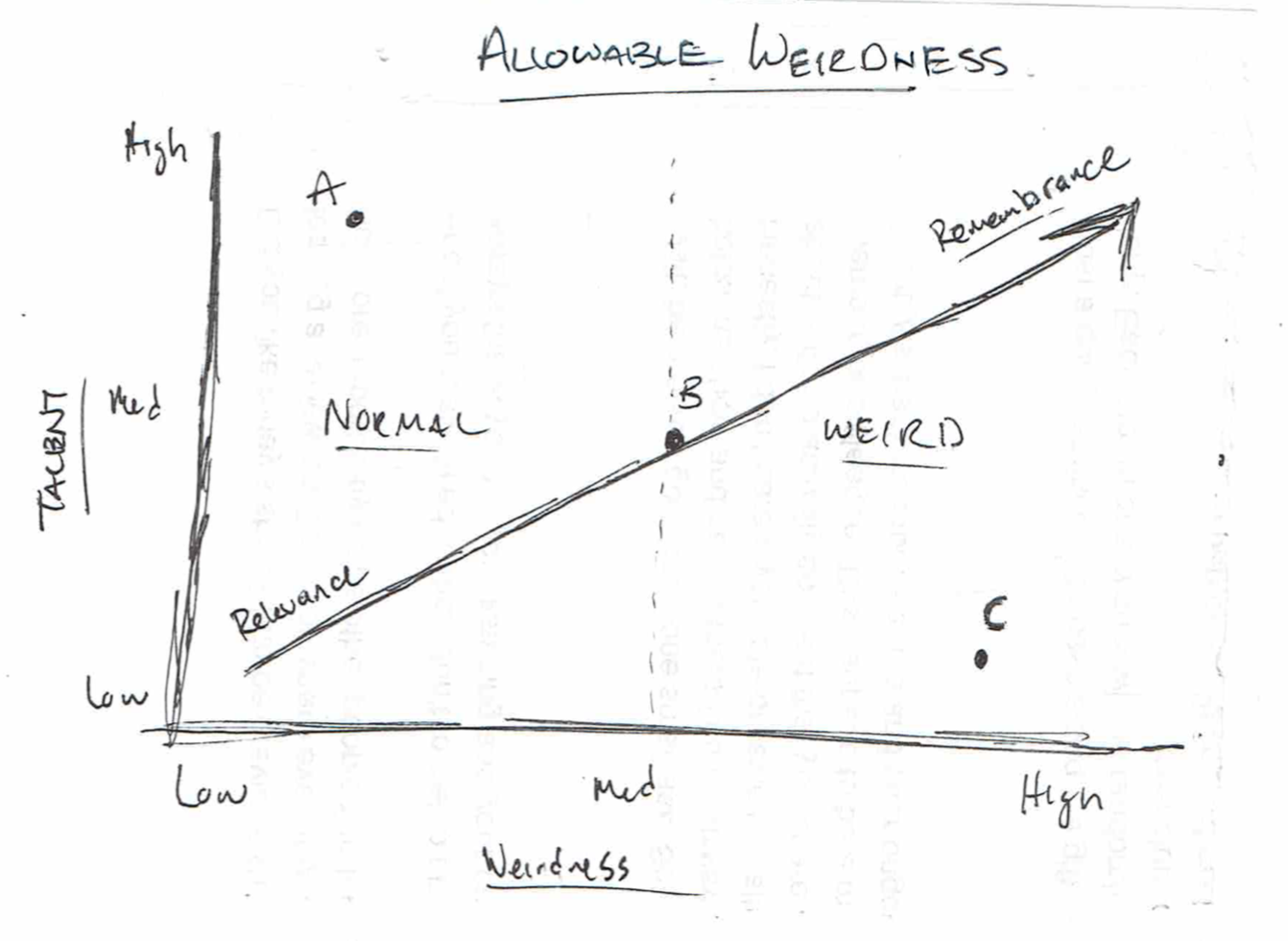
In short, if pumpernickel and peanut butter wasn’t any good, weirdness would suffer. It doesn’t completely make you null and void. Weirdness still has an alluring quality, but it’s really hard to compound weird that isn’t good. Assuming you want to be remembered, you have to be good at whatever you’re doing, too. Let me introduce you to Allowable Weirdness.
This chart represents a snapshot at any given moment. It doesn’t account for time, but we can make reasonable assumptions based on what we know from the Lifespan of Weird. The further you are from the relevance/remembrance line, the more uncertain it becomes whether you’ll be relevant or remembered. As you can see with point A, talent level is very high and weirdness very low. She’s likely good at whatever she does, and she’s probably compounded normal for a lot of years. Maybe she’s an executive, a top salesperson, or something of that nature. Or she’s got uncanny talent and she doesn’t have a lot of years under her belt. This is what they would call a natural. In either scenario, susceptibility of being remembered is pretty low, but she might be. Let’s look at point B now: talent level medium and weirdness medium. He falls right on the line, and this is basically a coin flip. If he was going to die tomorrow, he has a 50/50 shot at being remembered. Otherwise, keep honing skills, get a little weirder, and compound that weird, and his chances will surely go up. Lastly, you have point C: she’s undoubtedly a weirdo. She either never took the time to get better at whatever she’s doing, or she’s just really early on her career. This is the opposite of a natural. The former is pretty much screwed, but the latter still has time to get better.
The moral of this story: you need to be good at whatever you do. The good news is that compounding weirdness over time likely increases your talent. You get better at whatever you’re doing the longer you hang in there and do it. Time matters, and so does compounding. You’ll get more support from other weirdos, collaborate with weirdos, and you’ll witness the magic of compounding. Hunter S. Thompson was the weirdest of weird. He was also the most talented of talent. Michael Jackson, David Bowie, and Quentin Tarantino: all super weird. All super talented. I could put a bunch of names up here you’ve never heard of and tell you they weren’t talented at all, but what would be the point? You’ve never heard of them before. They’re not remembered. I want to hammer this home, though. Your goal is not to shoot for remembrance. That’s dumb and crazy. Your goal is to embrace your weird and realize your talent level should correlate with your weirdness; otherwise, all bets are off.
Do you need luck?
In short, yes.
We all need a little luck. The world is incredibly uncertain. There are infinite possibilities for every one thing that happens. You can look at this one of two ways, though. You can let uncertainty stunt you into inaction, or you can let it inspire you to act. Maybe you’re thinking, How is the latter possible? Well, since things change so quickly, whatever you do or are doing probably doesn’t matter as much as you think it does. As soon as you come to grips with the positive side of uncertainty, it’ll be significantly easier to embrace your weirdness. Basically, people just don’t care as much as you think they do. The more you embrace your weirdness, the more confidence you’ll get to continue embracing it, and it will become easier to compound it. Your irrelevant anecdotal weirdness will become rampant weirdness that will be harder for fellow weirdos to ignore.
With that being said, luck has two orders. I’m assuming that if you’re reading this, you’ve already passed the first order of luck. Congratulations! You’ve won the lottery. You were born a human being into an environment where you can amplify your weirdness. You are luckier than approximately four billion other human beings. I know because you’re likely reading this ebook on some digital device that has access to the internet. And as of 2018, roughly 3.8 billion people are internet users, which brings me to the second order of luck.
You’re probably thinking, Honestly, how likely am I to “make it,” “be found,” or “get picked?” I sort of brushed over this earlier, but I’ll attempt a second go at it now.
In my book The Gap, I documented how we’re living through a time of open and free distribution for content. This wasn’t always the case. It’s made huge strides over the last sixty or seventy years. Access wasn’t always easy. You had to get picked to go on TV, radio waves, or the big screen. But now, YouTube is a free platform. Instagram is a free platform. Facebook is a free platform. You can create a blog, podcast, or book. We have unlimited access both as creators and consumers. While I can surely tell you the issues I believe this has created, I do believe open access is largely a benefit for people who want to embrace their weirdness. It’s almost like a luck nullifier. Why? You have the ability to do, do, do. Act, act, act. Create, create, create. You have the ability to compound. If you’re good enough and weird enough, I think compounding your weirdness has a good chance at nullifying luck. Sure, it’s louder than ever before with more people making more noise than ever before. But this is even more of an ode to consistent and compounded weirdness. Your fellow weirdos will find you. It’s the weirdos who stop being weird that will suffer. They never get to experience the benefits from compounding. You just need time, talent, and weirdness. Access has leveled the playing field.
So rather than worrying about if you’re going to get lucky, I’d really start to consider a more important decision. Do you want to trade in your normal? That is the bigger decision. The harder decision. The more uncomfortable decision. Are you willing to make the trade-off that embracing your weird requires you to make? Are you ready to back normal into a corner and beat it to the ground day after day, month after month, and year after year?
Okay, now go be weird
In a 2018 conversation I had with Seth Godin, I asked him “What’s one piece of advice you wish you’d never hear someone give again?” He quickly replied, “Everything will be okay.” I couldn’t help but slightly chuckle and ask him to elaborate. He provided this very Seth-like follow up:
Well, reassurance is overrated. Way overrated. And if you need reassurance, you’re probably going to need more reassurance. So a little reassurance is stupid. I think we should dispense with reassurance and say, everything is probably not going to be okay. But even if it’s not okay, you’re resilient enough that you will figure out a way through.
So I wanted to pass that along to you and remind you that I’m not going to be there to reassure you to be weird forever. This was one of the most impactful pieces of advice I’ve heard from an individual who has definitely compounded weird over a lifetime. This is my final call for you to be weird. Then you’re just going to have to be it.
Here are three logical suggestions for you:
1. Combine two normal traits
Pumpernickel and peanut butter is only an anecdotal case. Just as Thompson or any of the other people I’ve just mentioned. With that being said, weirdness leaves clues. Pumpernickel and peanut butter shows there might be something that you can replicate for your life. Something that reasonably makes sense, too. Pumpernickel and peanut butter combines two normal things together to be a weird breakfast choice. We see this show up again with Thompson. He combined unhinged writing and inserted himself into the narrative to create gonzo journalism. Dwayne Johnson combined humor and buffness to create The Rock. Two normal qualities that, when combined, create something weird in a new game. This kind of goes back to why context matters for being weird. Weird is normal in some games, so when you change the context, you’re not actually acting differently or doing anything different (for you), but your weird becomes an advantage.
I guess this begs the question, Do you have two qualities, talents, or skills that you can put together to be weird in your game? It’s at least something strategic you can stew on for a while. Something that won’t feel or be manufactured. It’s actually mindful weird. You’re thinking about how your weird fits into the game you’re playing to create an advantage. The only thing left to do will be compound it for the next 10, 30, or 50 years. As I’ve documented, early manufactured weird doesn’t work so well. This might be why crazy parents who try to manufacture weird for their kids’ hockey careers don’t have a good strategy. It’s manufactured weird. Someone else embraced weird for the kids. You have to choose weird for yourself; otherwise, weird won’t last long enough for you to really start seeing the benefits. As we see with the Lifespan of Weird, it’s hard to be weird. But I do believe we’re all weird in our own way, and you just have to embrace the weirdness that’s unique to you.
2. Leverage your imperfections
Michael Strahan played fifteen seasons with the New York Giants and won Super Bowl XLII. He was six-time all pro, NFL 2000s All-Decade Team member, and 2001 defensive player of the year, and he holds the NFL record for sacks in a season. He had an amazing pro football career—not only in performance, but he also earned over $76 million during his career.
For all his success, what’s the one thing Strahan has been most known for?
The gap between his teeth. This was and has been Michael Strahan’s trademark for his entire career. He clearly had the money to get his teeth fixed. But there’s just one problem with that: then he’d be normal. He’d lose his X factor. So what does Strahan do? He doubles down on it. Even inside an industry, television entertainment, that values straight teeth and perfect smiles, he leverages his imperfection.
He goes on to have an even more successful career off the field. He spent close to five years hosting Live! with Kelly and Michael, replacing the iconic Regis Philbin. He then went on to host Good Morning America, and not long after, ABC gave him his own show with co-host Sara Haines titled Strahan and Sara. And don’t forget his spot co-hosting FOX NFL Sunday during football season.
The world wants you to have straight teeth, long flowing hair, and a tight waistline. They want you to be normal. Despite what social media, TV, and the internet might fool you to believe, nobody is perfect. Not me, not you. Nobody. We’re all imperfect. Big noses. One eyebrow. I don’t know. We all have quirks. We all have weirdness that we’re trying to hide. But maybe you shouldn’t hide those imperfections at all? Maybe you should be doing the exact opposite?
3. Find your style
I’ve gone to the legendary Newport Folk Festival three times. I’ve seen many artists who I admire and love to this day. But I’ll never forget the first time I saw Langhorne Slim. It wasn’t just that he was totally committed. I mean, he ran out into the crowd, dropped to his knees, jumped around the stage, and sweated all over the place. Langhorne was all energy.
But Langhorne was wearing a royal deluxe Stetson hat. Tall center, brim all the way around, two indents front off-center, muted tone, and a darker band with an inline bow on the left side. He was wearing a loose white t-shirt with blue jean overalls tucked into slightly oversized cowboy boots. There’s no normal person in the world who you’d see walking around town wearing Langhorne’s getup. Yet Langhorne does. He’s known for his big quirky hats and funky style. So much so that Stetson designed their own Langhorne hat.
Quite often, you’ll hear somebody say, “She’s so fashionable. What great style.” Fashion is what’s in now. It’s dictated by fashion designers. It’s dictated by other people. It’s dictated by fashion weeks around the world, worn by celebrities, and then interpreted by fast fashion retailers like H&M and Zara. Fashion slowly makes its way into the general public. It becomes normal. So normal people often say, “Wow. You have such great style.” While this could totally be true, the problem I have is that most people confuse these two things—fashion and style.
Style is dictated by you. Style is unique. Style is your creation. Style is more of a statement about who you are than what was worn on the runway. Style is Langhorne Slim wearing big hats and funny overalls. Style is Hunter Thompson walking around with aviator shades, hiked-up shorts, and a leather satchel. Style should be treated completely independent of fashion. Style is weird.
Style doesn’t just have to be clothes. Style is how you play the song, write the article, or paint the painting. “Fashion” is the songs that are in right now, articles the world wants to read right now, and paintings the world wants to see right now. So play with different styles, but when you find the one that you feel expresses your weirdness, stick with that style.
One more for the road?
In 1970, Hunter S. Thompson was living in Woody Creek, Colorado. A small town located fifteen minutes north of Aspen and a place he called home for many years. He didn’t like the direction the county was heading. So, Thompson did what Thompson does. He embraced his weirdness.
He ran for sheriff of Aspen.
Maybe you’re thinking, Are you kidding me? Thompson for sheriff?
No joke, though. Thompson even shaved his head, just to be able to call the incumbent “my long-haired opponent.” He was all in.
The front cover of Rolling Stone on October 1, 1970, read, “‘Freak Power in the Rockies’ by Dr. Hunter S. Thompson.” Yes, Dr. Hunter S. Thompson. You didn’t forget about that whole doctor thing, did you?
Here’s an abbreviated version of the Freak Power ticket he ran on:
Sod the streets at once. Rip up all the city’s streets with jackhammers...The only automobiles allowed into town would be limited to “delivery-alleys”...All public movement would be by foot and a fleet of bicycles, maintained by the city police force.
Change the name “Aspen,” by public referendum, to “Fat City.” This would prevent greedheads, land-rapers, and other human jackals from capitalizing on the name “Aspen.”
Drug sales must be controlled. My first act as Sheriff will be to install, on the courthouse lawn, a bastinado platform and a set of stocks–in order to punish dishonest dope dealers in a proper public fashion...This approach, we feel, will establish a unique and very human ambiance in the Aspen (or Fat City) drug culture–which is already so much a part of our local reality that only a Falangist lunatic would talk about trying to “eliminate it.”
You might be left shaking your head. Possibly laughing out loud. The first time I read this story, I couldn’t control myself. Here’s what some of the people who were part of the campaign had to say about it:
Joe Edwards, a lawyer who ran Thompson’s campaign said, “On election night, Hunter wound up losing by, I think, 274 votes out of 2,000 or 3,000. It was pretty damn close. The night of the election was wild. Hunter was walking around with his cigarette holder and his shaved head and an American flag wrapped around his neck, and people were cheering.”
Jann Wenner remembers, “Had he taken it a little more seriously at the start, or had it been his second try, he would’ve been elected Sheriff.”
Tom Benton, local artist who designed Thompson’s campaign posters, was convinced, “If we had another two weeks, he’d have been Sheriff.”
Paul Pascarella, an artist living in Aspen, captured it best: “I think what lost him the few hundred votes he needed was his idea of changing the name of Aspen to Fat City. These old people got all upset...It showed me that voting worked. We changed this little valley by registering to vote and coming out with some posters and doing the work and getting all the freaks involved.”
Perhaps that last line from Pascarella might sum this whole ebook up. Not only did Thompson have the courage to embrace his weirdness, but all the other weirdos came out in support of him. He was leveraging “freak” power. In other words, he was betting on weird embracing weird, and it almost paid off.
You see, that’s why weird works.
The last reassurance you’ll get from me—ever!
Just like anything else, weird is nothing more than a story. You have to tell yourself the story of weird just as you would any other story. You have to believe weird makes a BIG difference in your life and work. You have to believe weird is the X factor that will get you or your work remembered. You have to believe your weirdness is magical. Do you believe in the story of weird? I don’t know, but you should.
I often think to myself that people need only two things to do great work: other weirdos, and permission. The former is quite obvious. You need weirdos to help you, support you, and join you. The latter is what I think people struggle with in life. They think they need money, experience, skills, time—you name it, they think they need it. They’ll read the memes on Instagram, watch YouTube videos, and listen to the podcasts telling themselves that story of what they need to start. Start what, you ask? Start anything. But they’re lying to themselves.
What they’re really looking for is permission. They want someone to tell them it’s going to be okay. But like Seth said, it probably won’t be, and that’s okay. You’re strong enough to get through it, and you’ll have to be if you want to embrace your weird in the face of normal.
Now go find your pumpernickel and peanut butter. It’ll be worth it.